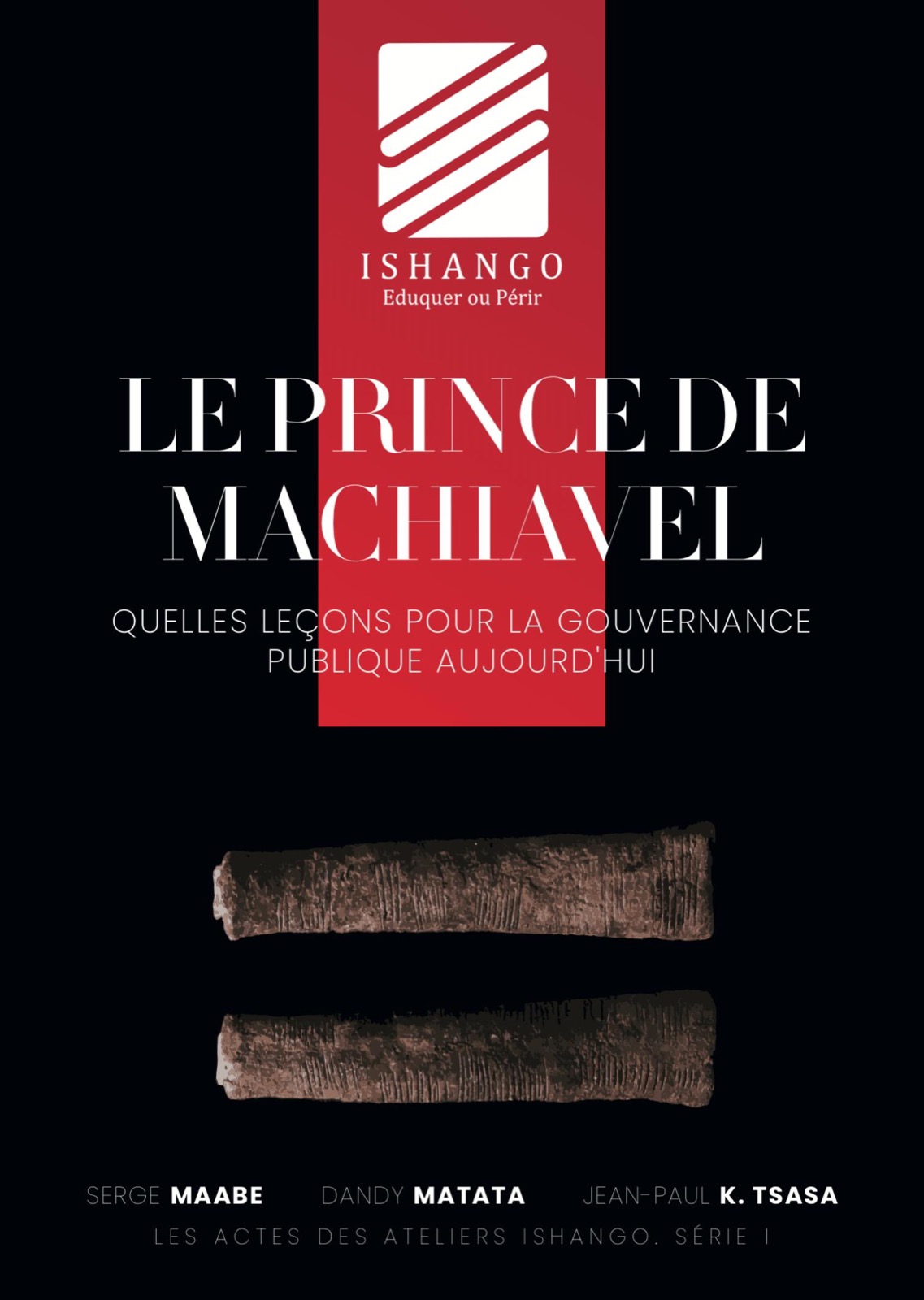
Le Prince de Machiavel
Quelles leçons pour la gouvernance publique aujourd'hui ?
Serge Maabe Muanyimi, Amsini Dandy Matata, Jean-Paul K. Tsasa
Price to be announced
Ishango Press publishes the work of the think tank and manuscripts by authors who take the Democratic Republic of the Congo as their subject: essays, research and policy briefs, edited with the care an exacting reader is owed.
3
2
1
Quelles leçons pour la gouvernance publique aujourd'hui ?
Serge Maabe Muanyimi, Amsini Dandy Matata, Jean-Paul K. Tsasa
The catalogue is organised in series, each with its own rule and its own readership.
La collection d'origine, et celle où la maison a commencé. Elle publie ce qui touche à l'organisation du pouvoir : constitution, institutions, pensée politique, gouvernance publique. On y trouve aussi bien la relecture d'un classique que l'examen d'une réforme en cours. Le critère n'est pas l'actualité du sujet mais la tenue de l'argument : un texte y entre s'il défend une thèse et en assume les conséquences, y compris lorsqu'elles dérangent. Couverture noire, barre carmin.
02 titles
Finances publiques, macroéconomie, politiques budgétaires et monétaires, économie du développement. La collection accueille les travaux qui prennent l'économie congolaise pour objet et non pour illustration. Le niveau technique y est assumé : un modèle s'y écrit, une série s'y discute. Mais la démonstration doit rester suivie par un lecteur attentif qui n'est pas du métier — c'est la limite que la maison se donne, et elle est contraignante.
01 title
Those whose work the press publishes. Most of them write from the Congo, and that is what gives the catalogue its purpose.
What holds an essay in political economy and a collection of short stories together in the same catalogue comes down to three requirements. They apply to every genre, and they are not negotiable.
A text enters the catalogue if it defends something and sees it through, even where that contradicts a publication of the think tank.
Claims rest on sources a reader can go and consult. That is what separates an essay from a long opinion.
Outside the circle of specialists, work that nobody reads changes nothing. The press publishes in French, Lingala and Kiswahili.
Every manuscript is read by two members of the reading committee, one of them a researcher from outside the press; the author receives a reasoned answer, favourable or not, within a period announced at submission. Books are printed in Kinshasa wherever quality allows, and policy briefs remain free to download: they are made to be read by those who decide.
The press reads the manuscripts sent to it, all year round. Essays, academic work reworked for a general readership, documented investigations, testimony grounded in fact: the genre matters less than the quality of the writing.
Submissions are made from your personal account. You then follow each stage there, from acknowledgement of receipt to the committee's decision.
Submission is free and will remain so. We do not practise vanity publishing.